Most people who go looking for a gut supplement are really looking for a quieter, more predictable digestive day: fewer heavy afternoons, less bloating after dinner, a morning that runs on schedule. The habits that shape that are unglamorous and mostly free, and they work in the order they happen. This note lays them out as a routine you can run from breakfast to bedtime, then explains, last, where a fiber powder or a probiotic fits and what the evidence for each honestly supports.
What the routine is working with
The digestive tract is a long, muscular tube that moves food along by a wave-like squeezing called peristalsis, breaking it down with acid and enzymes in the stomach, absorbing most nutrients in the small intestine, and absorbing water in the large intestine as it turns what is left into stool. It is not on autopilot. NIDDK describes two sets of controls: signals from the brain (the smell of food starts saliva before you take a bite) and the gut's own nervous system, whose nerves release substances that speed up or slow down the movement of food and the release of digestive juices. Bacteria in the large intestine help break down what remains and make vitamin K.
Two things follow. The gut responds to cues, so regularity is something it can learn. And because water, fiber and movement all act on the same slow conveyor, they work better together than any one of them alone. That is the whole logic of the routine below.
The routine, in the order it happens
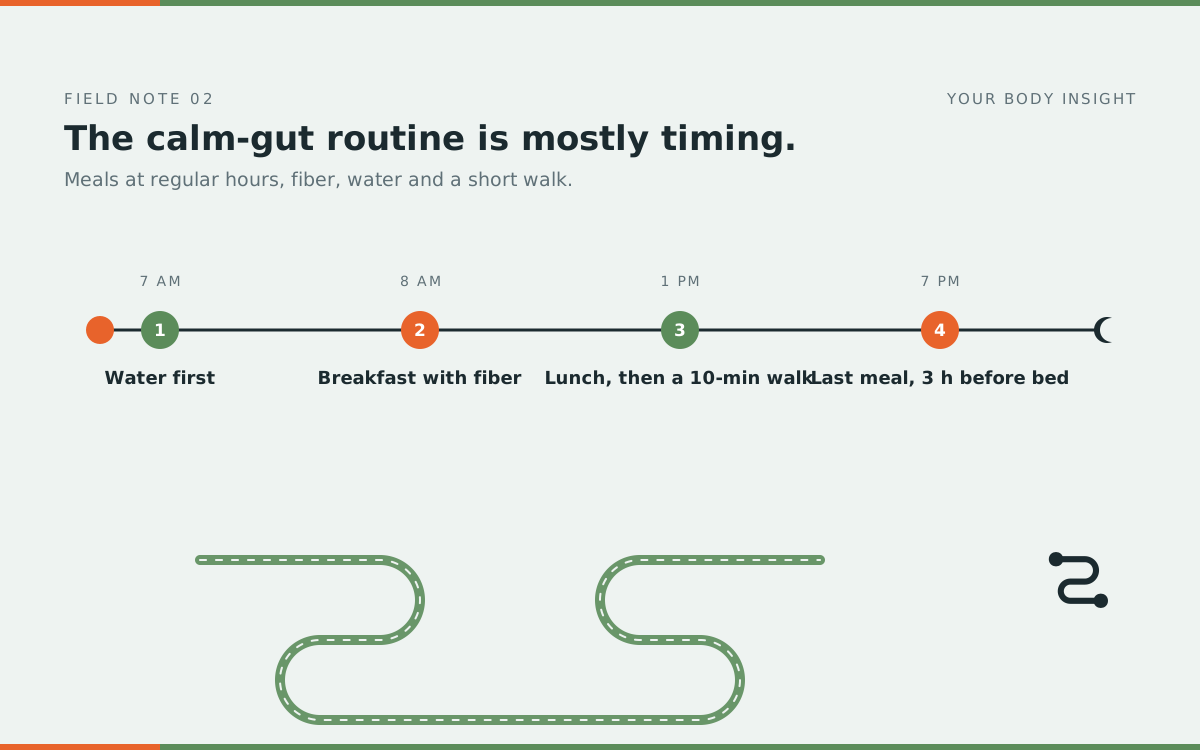
- Eat at roughly the same times each day. Pick a breakfast, lunch and dinner window and keep to it within about an hour, including weekends. A 2025 review in Current Nutrition Reports that pulled together 31 studies concluded that consistent meal timing, and in particular eating earlier in the day, is linked with a more stable gut microbial community and better gut barrier function, while irregular timing was associated with the opposite; much of that work is early and some of it comes from animal studies, so treat it as a reason to be regular, not a promise.
- Put fiber and water in the same meal. NIDDK's guidance for adults is 22 to 34 grams of fiber a day depending on age and whether you are a man or a woman (the FDA Daily Value used on labels is 28 g), from oats, whole-grain bread, beans and lentils, berries, apples with the skin, pears, broccoli, carrots and nuts. Fiber holds water as it moves, so NIDDK pairs the advice with drinking water and other liquids "to help the fiber work better." A glass with each meal is the simplest version, and it is also the one people forget first when they add a fiber powder, which is why the water rule comes up again below.
- Add fiber slowly. If you are well under the target, NIDDK's advice is to add it a little at a time so your body gets used to the change. Jumping from 12 g to 30 g in a day is an easy way to give yourself the gas and bloating you were trying to avoid. A week per extra serving is a reasonable pace.
- Walk for 10 to 15 minutes after your largest meal. A small German study in ten healthy men measured, by ultrasound, how fast the stomach emptied a large meal when it was followed by a small glass of water, an espresso or one of several alcoholic digestifs, or by water and a slow treadmill walk. The slow walk shortened the stomach's half-emptying time from about 123 minutes to about 107 minutes; none of the drinks changed it. The walk did not change how full or bloated the men said they felt, though, and ten people is a small sample, so treat this as a plausible, low-cost habit rather than a proven fix. The 10 to 15 minutes is our suggestion, not the study's protocol.
- Set a last-meal cut-off two to three hours before bed. The same meal-timing research that favors regular, earlier eating also treats meals eaten out of step with the body clock, late or irregular, as the pattern linked with disruption, and the sleep guidance from the CDC and the American Academy of Sleep Medicine independently says not to eat a large meal close to bedtime. Choose a clock time, and if you are genuinely hungry after it, keep it to something small. A cut-off also does quiet work for the next morning: a stomach that finished its job before you lay down is one less thing running on a delay when you get up.
- Keep the morning the same, too. Wake at about the same time, drink a glass of water, eat breakfast in the window you chose, and leave time before you leave the house. Many people find that their body settles into a predictable morning rhythm when the evening before was predictable, and a rushed morning is the easiest way to lose it.
Regular meal times, fiber with water, a walk after the big meal and an evening cut-off all act on the same slow conveyor. Do them in that order for two weeks before you decide anything about a supplement.
Where a fiber powder fits
A fiber supplement is a way to close the gap between what you eat and the 22 to 34 g target when food alone is not getting there; it is not a replacement for the food, which brings the vitamins, minerals and variety a powder does not. Psyllium husk, the fiber in Metamucil, is a soluble fiber that forms a gel in water, and that property is exactly why the water rule matters more here than anywhere else in this routine. Federal labeling rules require dry psyllium foods that carry the FDA-authorized psyllium fiber health claim, and bulk-forming psyllium laxative products, to warn that the product must be taken with at least a full glass of liquid, that taking it without enough liquid may cause choking, and that people who have difficulty swallowing should not use it; the Metamucil canister carries that warning. Read the serving line for grams of soluble fiber, start with one serving a day rather than the maximum, and count it toward your daily total instead of on top of it. Procter & Gamble markets Metamucil for digestive regularity; the entry linked above reads the panel and dates the price.
Where a probiotic fits, and what to expect
Probiotics are live microorganisms taken in the hope of a benefit, and the honest summary from NCCIH is that they have a long history of apparently safe use in healthy people, that the evidence is inconsistent for most of the purposes people buy them for, and that "much remains to be learned about whether they're helpful and safe." The most useful thing NCCIH says for a shopper is that effects are specific: a result for one kind of Lactobacillus does not mean another Lactobacillus, or any Bifidobacterium, would do the same. So the label question is not "how many billion" but "which named strains, and is the CFU count promised through the expiration date." Our Garden of Life Once Daily entry works through both questions on a real label; Garden of Life markets it for digestive health, which is the seller's position, not ours.
If you try one, run it the way you would run any experiment: after the routine above is in place, one product at a time, for a few weeks, with a note of what actually changed. NCCIH also flags that the risk of harm is greater for people with serious illness or whose defenses are weakened by illness or medication, who should ask a clinician first.
Any product, powder or capsule, sold as the reason your gut is unsettled. New or persistent changes in digestion, ongoing pain or blood in the stool are reasons to see a clinician, not to try a supplement.
A two-week way to test it
Write down your three meal windows and your cut-off time. For fourteen days, keep to them, drink a glass of water with each meal, add one fiber-rich food per week, and walk after dinner. Keep a two-line note each night: how the afternoon felt, and whether the morning ran on time. At the end of two weeks you will know which habit moved the needle for you and which did not, and that is a far better basis for deciding on a powder or a capsule than a listing page can be. If you take medication, have a diagnosed digestive condition or are pregnant, ask a clinician before changing your fiber intake or starting a probiotic; fiber can also change how some medicines are absorbed, so spacing may matter.
Sources
- NIDDK, National Institutes of Health. Your digestive system and how it works: peristalsis, the role of the nervous system, bacteria in the large intestine, water absorption. niddk.nih.gov
- NIDDK, National Institutes of Health. Eating, diet and nutrition guidance on fiber: 22 to 34 grams a day for adults, add fiber gradually, drink water and other liquids with it, and food sources. niddk.nih.gov
- U.S. Food and Drug Administration. Daily Value on the Nutrition and Supplement Facts labels (dietary fiber Daily Value of 28 g). fda.gov
- Bajaj P, Sharma M. Review of 31 studies on meal timing, circadian rhythm and the gut microbiome. Current Nutrition Reports, 2025. pubmed.ncbi.nlm.nih.gov
- Franke A, Harder H, Orth AK, Zitzmann S, Singer MV. Small randomized study in ten healthy men comparing gastric emptying of a meal followed by water, espresso, several alcoholic digestifs, or water plus slow treadmill walking. Journal of Gastrointestinal and Liver Diseases, 2008. pubmed.ncbi.nlm.nih.gov
- Legal Information Institute, Cornell Law School. 21 CFR 101.17(f): required label notice for dry psyllium-husk foods that bear the psyllium soluble-fiber health claim. law.cornell.edu; and 21 CFR 201.319: required choking warning and full-glass directions for OTC drug products whose active ingredient is a hydrophilic gum or mucilloid such as psyllium. law.cornell.edu
- National Center for Complementary and Integrative Health. Probiotics: what you need to know. nccih.nih.gov
- Centers for Disease Control and Prevention. About sleep: habits including avoiding large meals before bedtime. cdc.gov
- American Academy of Sleep Medicine. Healthy sleep habits, including not eating a large meal before bedtime. sleepeducation.org
This article is educational and is not medical advice. Ask a qualified clinician before starting any supplement or changing a routine, especially if you take medication.