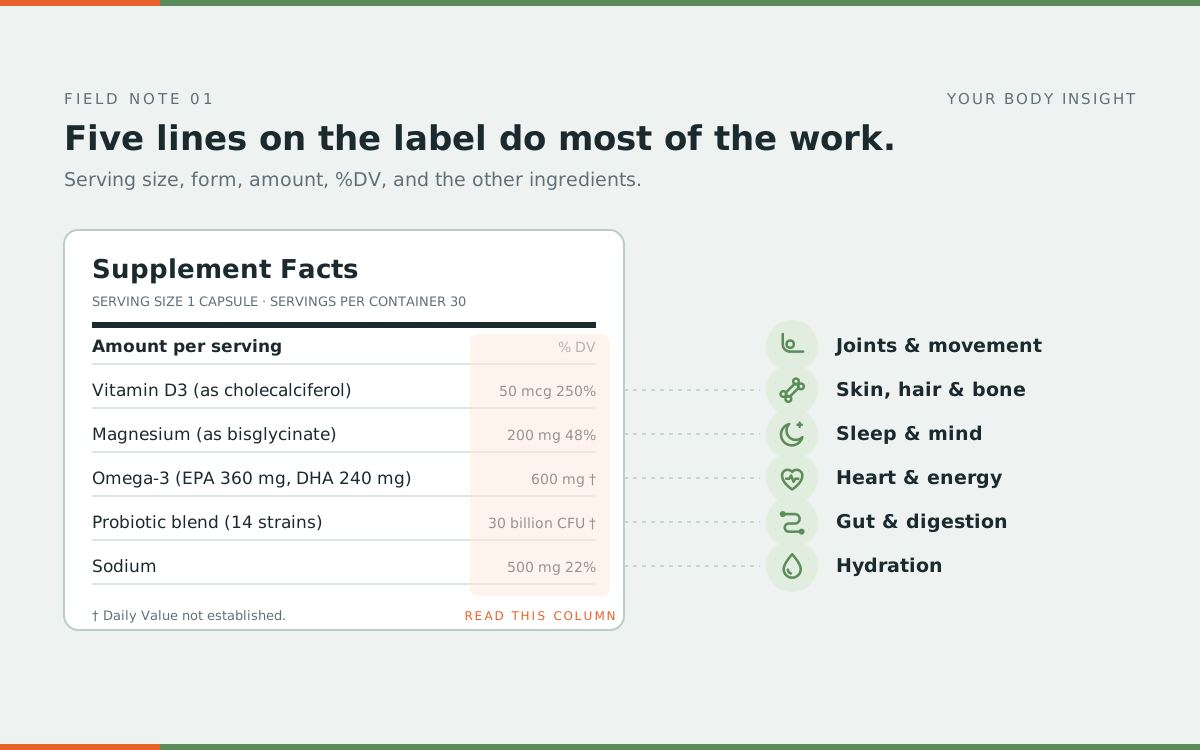
The front of a supplement box is advertising. The Supplement Facts panel on the back is the one part of the package the FDA regulates line by line, and it answers most of the questions people bring to a product: how much is really in a dose, in what form, and what else came along for the ride. This note walks through the five lines every panel shares, then shows which single line to find first for each body system on this site, using entries from our own catalog as worked examples.
Line one: the serving size
Everything on the panel is "per serving," and the manufacturer decides what a serving is. Under FDA labeling rules, one serving of a dietary supplement is the maximum amount the label recommends per eating occasion, or, if the label gives no recommendation, one unit: a tablet, a capsule, a scoop, a packet. That is why two bottles that both say "600 mg" on the front can deliver very different amounts per capsule, and why a 30-count bottle can be a two-week supply.
Two habits make this line useful. First, read the serving size before any amount below it. Second, check how many servings you would actually take in a day, then multiply. A calcium tablet whose label directs "1 tablet 1 to 2 times daily" is a 600 mg product or a 1,200 mg product depending on how you use it, and the second number is the one that matters against a daily upper limit.
Line two: the form, in parentheses or below the panel
The name of an ingredient tells you what it is; the form tells you how it was delivered. FDA's labeling guide lets a brand name the source of a dietary ingredient (for example, which magnesium compound was used) in parentheses right after the nutrient name in the panel, "Magnesium (as magnesium bisglycinate)" or "Calcium (as calcium carbonate)", in which case it need not be repeated in the ingredient statement below; salts used as binders or fillers go in that ingredient statement. The number on the panel is the amount of the mineral itself, usually called the elemental amount, not the weight of the whole compound. A scoop can weigh several grams and still contain 200 mg of magnesium; the rest is the glycine it is bound to, plus flavoring.
Line three: the amount, not the headline
The rule says the quantitative amount by weight per serving must sit immediately after the ingredient name or in its own column. This is the line to read instead of the big number on the front. The most common mismatch is fish oil: a "1200 mg" softgel describes the oil, and the omega-3 fatty acids inside that oil are listed separately, and are always smaller. Turmeric extracts and protein powders follow the same pattern.
One more rule worth knowing: if a product uses a "proprietary blend," the label must list the total weight of the blend and name its ingredients in descending order by weight, but it does not have to give the amount of each one. A blend is not a red flag by itself, but it does mean you cannot compare that product's individual ingredients against a study dose.
Read amounts per serving, in the form named, and then multiply by how many servings you will take in a day. The number on the front of the box is rarely the number you need.
Line four: percent Daily Value and the dagger
The %DV column tells you how much of a reference daily amount one serving supplies. FDA calculates it by dividing the amount on the panel by the established Daily Value for that nutrient. As a quick screen, FDA describes 5% DV or less per serving as low and 20% DV or more as high. The current adult Daily Values you will meet most often on this site are 420 mg for magnesium, 1,300 mg for calcium, 2,300 mg for sodium, 4,700 mg for potassium, 20 mcg for vitamin D and 28 g for dietary fiber.
Many ingredients have no Daily Value at all. Fish-oil omega-3s, probiotics, collagen peptides, curcuminoids and CoQ10 all fall into this group. FDA requires these to be flagged with a symbol in the %DV column, usually a dagger or asterisk, pointing to the footnote "Daily Value not established." That symbol is not a warning. It simply means there is no official daily reference amount to compare against, so the panel cannot tell you whether a dose is high or low; the only useful comparison is the amount used in research.
Line five: "Other ingredients"
Below the panel sits the ingredient statement, and this is where sweeteners, capsule material, flow agents, colors and allergen sources live. It is the line to read for a monk fruit or sucralose sweetener in a powder, for gelatin versus a plant-based capsule, for "contains: fish" or "contains: shellfish," and for the specific salt of a mineral if it was not printed in parentheses above. A product can look identical on the panel and differ only here.
Now the one number per body system
Once you can find those five lines, shopping by body system becomes a matter of knowing which line to find first. The system a product sits under on this site is the position its seller markets it for, not our finding; what follows is only where to look on the panel.
Heart & energy: the omega-3 line
Skip the fish-oil milligrams and find "Omega-3 fatty acids" and, if listed separately, EPA and DHA. On the manufacturer's page for the Nature Made Fish Oil 1200 mg entry, a two-softgel serving lists 2,400 mg of fish oil, 720 mg of total omega-3 fatty acids and 600 mg of EPA and DHA, so the front-of-box figure (1,200 mg of oil per softgel, against 300 mg of EPA and DHA) is four times the EPA + DHA number. Nature Made markets this product for heart health; the omega-3 line is the one to compare.
Sleep & mind: elemental magnesium
Magnesium labels are where the form line earns its keep. The panel amount is the mineral itself: a scoop of the Thorne Magnesium Bisglycinate powder lists 200 mg of magnesium "as magnesium bisglycinate," with citric acid and monk fruit concentrate in the other-ingredients line. Two reference points sit alongside that number. The adult RDA is 400 to 420 mg a day for men and 310 to 320 mg for women, and the Tolerable Upper Intake Level for magnesium from supplements specifically is 350 mg a day, a limit set at the highest daily supplemental amount unlikely to cause diarrhea or stomach upset in almost everyone. Food magnesium does not count against that 350 mg; supplement magnesium does, so add up every product you take.
Gut & digestion: CFU and named strains
Probiotic panels are the odd ones out. By regulation the amount must be declared by weight, but in a 2018 draft guidance (still a draft) FDA said it intends not to object to brands also listing colony forming units (CFU) on the panel, calling CFU a useful description of the quantity of live microbes. So the CFU number is the one to read, and the question to ask is whether it is promised at the time of manufacture or through the expiration date; the label or the brand's page usually says which. Then read the strain list. NCCIH is blunt that different probiotics can have different effects, and that a result for one kind of Lactobacillus does not carry over to another kind or to a Bifidobacterium. Our Garden of Life Once Daily probiotic entry walks through exactly that list. For a fiber powder such as Metamucil, the lines to find are grams of soluble fiber per serving and the fluid notice: federal rules require dry psyllium foods that carry the psyllium fiber health claim, and bulk-forming psyllium laxative products, to warn that they must be taken with at least a full glass of liquid, and the Metamucil canister carries that warning.
Hydration & daily basics: sodium per stick
Electrolyte mixes use a Nutrition Facts panel rather than a Supplement Facts panel, but the reading habit is the same: find sodium, potassium and total sugars per stick, and compare the sodium against the 2,300 mg Daily Value. That number is the trade-off in a single line. It is what makes a stick useful after a long, sweaty session and what makes it unnecessary at a desk. The Liquid I.V. entry lays the panel out and dates the price.
Skin, hair & bone: the calcium form
For calcium, the parentheses decide how you take it. Calcium carbonate, the form in the Nature Made Calcium 600 mg with D3 tablet, should be taken with meals; calcium citrate can be taken with or without food. Two figures from the Linus Pauling Institute belong next to any calcium label: absorption is best when you take no more than 500 mg of elemental calcium at a time, and the Tolerable Upper Intake Level is 2,500 mg a day for adults 19 to 50 and 2,000 mg for adults 51 and older, counting food and every supplement together. The same tablet's vitamin D3 line, 10 mcg (400 IU), is the one to add to any multivitamin you take.
Joints & movement: curcuminoids, not turmeric
Turmeric labels almost always headline the whole extract. The Qunol Turmeric panel, for example, lists a 1,000 mg "turmeric complex" per two-capsule serving at 20% curcuminoids, which puts the curcuminoid content at roughly 200 mg. Curcuminoids are the part research is usually about, so that derived number is the one to carry to a study. NCCIH's summary of the evidence is that we do not yet know enough to say whether turmeric or curcumin is helpful for any health purpose, and that liver injury has been reported in some people using high-absorption formulations. Qunol markets its product for joint comfort; the panel tells you the dose, the research tells you how much is known, and the two should be read together.
A five-step reading routine
- Find the serving size. It is the first line under the title, and every number below it is per that serving.
- Read the form. Look in parentheses after the nutrient name, or in the ingredient statement below the panel.
- Read the amount, then multiply. Per serving, times servings per day, is the number to compare against an RDA, an upper limit or a study dose.
- Check the %DV column. Use 5% as low and 20% as high; a dagger means no Daily Value exists, so compare with research instead.
- Read "Other ingredients." Sweeteners, capsule material, allergen sources and mineral salts all live here.
None of this tells you whether a product will do anything for you; that is a separate question the evidence section of each entry tries to answer honestly. What the panel does give you is a fair basis for comparison. If you take medication or have a health condition, run any new supplement past a clinician or pharmacist before you start.
Sources
- U.S. Food and Drug Administration. Dietary Supplement Labeling Guide, Chapter IV: Nutrition Labeling (serving size, amount declaration, %DV, "Daily Value not established" footnote, proprietary blends, form in the ingredient statement). fda.gov
- U.S. Food and Drug Administration. Daily Value on the Nutrition and Supplement Facts labels: the 5% / 20% guide and current Daily Values for calcium, magnesium, sodium, potassium, vitamin D and dietary fiber. fda.gov
- U.S. Food and Drug Administration. Draft guidance for industry on quantitative labeling of dietary supplements containing live microbials (enforcement discretion for CFU declarations in addition to weight), September 2018. fda.gov
- Legal Information Institute, Cornell Law School. 21 CFR 101.17(f): required label notice (full glass of liquid) for dry psyllium-husk foods that bear the psyllium soluble-fiber health claim law.cornell.edu; and 21 CFR 201.319: required choking warning and full-glass directions for OTC drug products whose active ingredient is a hydrophilic gum or mucilloid such as psyllium law.cornell.edu
- Linus Pauling Institute, Oregon State University. Magnesium: RDA for adults, supplement forms, and the 350 mg/day Tolerable Upper Intake Level for supplemental magnesium. lpi.oregonstate.edu
- Linus Pauling Institute, Oregon State University. Calcium: RDA, upper intake levels by age, timing of carbonate versus citrate with meals, and the 500 mg-at-a-time absorption note. lpi.oregonstate.edu
- National Center for Complementary and Integrative Health. Probiotics: what you need to know (strain-specific effects, regulation, safety). nccih.nih.gov
- National Center for Complementary and Integrative Health. Turmeric: state of the evidence, absorption, and safety notes including reports of liver injury with high-absorption formulations. nccih.nih.gov
- Nature Made. Fish Oil 1200 mg softgels product page (Supplement Facts as read September 30, 2026). naturemade.com
- Thorne. Magnesium Bisglycinate product page (Supplement Facts as read September 30, 2026). thorne.com
- Nature Made. Calcium 600 mg with Vitamin D3 tablets product page (Supplement Facts as read September 30, 2026). naturemade.com
- Qunol. Extra Strength Turmeric Curcumin Complex 1000 mg product page (Supplement Facts as read September 30, 2026). qunol.com
This article is educational and is not medical advice. Ask a qualified clinician before starting any supplement or changing a routine, especially if you take medication.