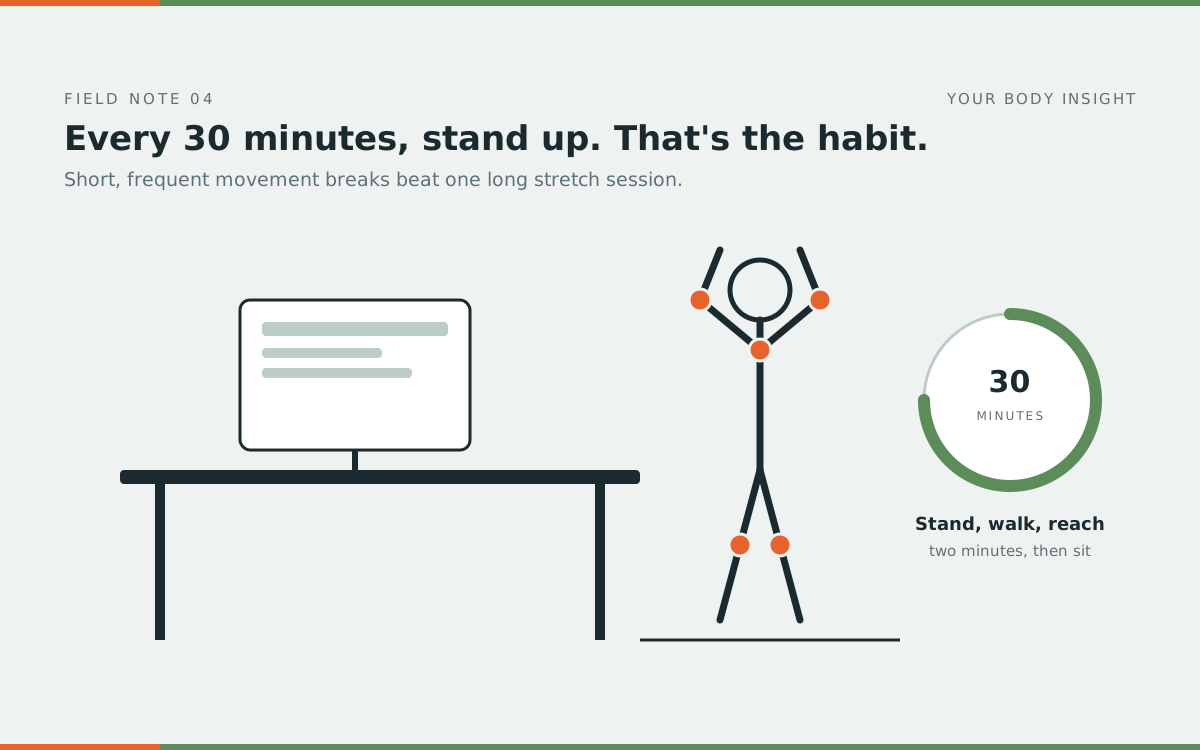
If you work at a desk, the honest answer to “what should I do for my joints?” is not a product. It is a rhythm: stand up and move for about two minutes every 30 minutes, set the workstation up so your joints rest in neutral positions in between, and hand the remembering to a timer. This note gives you the numbers behind each of those three pieces, the two-minute break we use in order, and a plain reading of the supplements people buy alongside the habit.
What the guidelines actually ask of a desk worker
The federal Physical Activity Guidelines for Americans (second edition, 2018) open their adult section with one sentence that matters more for office workers than any exercise plan: “Adults should move more and sit less throughout the day. Some physical activity is better than none.” The second edition also dropped the older requirement that adult activity occur in bouts of at least 10 minutes, so short stretches of movement now count. For the week as a whole, the target is 150 to 300 minutes of moderate-intensity activity (a brisk walk qualifies), plus muscle-strengthening work on two or more days (source 1).
None of that is joint-specific, and we are not going to pretend it is. The guidelines are about general health; what they give a desk worker is permission. A one-minute walk to the printer is not “too short to count.” Stiffness after a long sit is a familiar feeling, and the first few steps after a two-hour meeting are rarely the smoothest of the day. Whether short breaks change anything about joint health over years is not a question the research has settled, and we will not claim it does. What short breaks do have is a measurable effect on other things, and that is where the 30-minute number comes from.
Why every 30 minutes
The most careful dose-finding study we found is small but well designed. In 2023, researchers published a randomized crossover trial in Medicine & Science in Sports & Exercise: 11 middle-aged and older adults each sat through five separate eight-hour laboratory days. One day was uninterrupted sitting; on the other four they took light walking breaks of one or five minutes, every 30 or every 60 minutes. Only one schedule, five minutes of walking every 30 minutes, significantly blunted the rise in blood sugar after meals. Every break schedule, even one minute per hour, lowered systolic blood pressure readings compared with sitting straight through, with the largest drops for the five-every-30 and one-every-60 schedules (source 2).
Read that with its limits in view: eleven people, one day per condition, in a laboratory, measuring blood sugar and blood pressure rather than knees or hips. We borrow the 30-minute interval for two reasons. It is the interval with the best evidence for a measurable benefit of any kind, and it is short enough that stiffness never gets much time to build. OSHA’s computer-workstation guidance points the same direction from the ergonomics side: “Every hour, take a five-minute break from computer tasks. Look away, stretch, get up, or walk,” with shorter “micro breaks or rest pauses” for jobs that hold a static posture (source 3). Treat OSHA’s hourly break as the floor and the 30-minute stand-up as the habit.
Two minutes every 30 minutes is about 7 percent of a working day. Over eight hours it adds up to roughly half an hour of standing and walking you would otherwise have spent in one position, without a single “workout.”
The two-minute break, in order
Here is the sequence we actually use. It is deliberately boring: the goal is a break you can repeat sixteen times a day without deciding anything. Move within a comfortable range, never into pain, and skip any step that bothers you.
- Stand and walk for one minute. Go somewhere with a purpose: refill your water, deliver a message in person, take the long way to the restroom. A purpose beats pacing because it is easier to start.
- Hips: a standing lunge, 20 seconds a side. Step one foot back, keep the torso tall and tuck the pelvis slightly until you feel a gentle stretch at the front of the back leg’s hip. Hold the desk edge for balance.
- Knees: eight to ten chair stands. Sit back down to a light touch of the seat and stand again without using your hands. Slow is better than fast; it is the same movement the day asks of you dozens of times anyway.
- Wrists and forearms: 15 seconds each way. Extend one arm, palm up, and use the other hand to draw the fingers gently back; then palm down, fingers toward the floor. Finish with slow wrist circles and a few open-and-close fists, then switch arms.
- Shoulders and neck: ten seconds. Roll the shoulders back three times, then draw the chin straight back, hold for a breath, and let it go.
- Sit down and reset. Feet flat, hips to the back of the chair, elbows level with the keyboard (details in the next section). Then start the timer again.
If you have a diagnosed joint condition, a recent injury, or a surgeon or physical therapist who has given you specific instructions, their instructions win over this list. Ask before adding anything new, including any of the drills above.
A five-minute workstation check, with OSHA’s numbers
Between breaks, the set-up decides what position your joints rest in for the other 28 minutes. OSHA’s Computer Workstations eTool is the source we trust here because it is specific, public and free. Its numbers, section by section:
- Monitor. The top of the screen at or slightly below eye level, with the center of the screen 15 to 20 degrees below the horizontal line of sight, and the screen 20 to 40 inches from your eyes. Set it perpendicular to a window to cut glare. Bifocal wearers should place the monitor lower than the standard so the head is not tipped back to read (source 4).
- Chair. Height is right when the entire sole of the foot rests on the floor “with the back of the knee slightly higher than the seat of the chair”; use a footrest if the chair will not go low enough. The backrest should have a height-adjustable lumbar support and recline at least 15 degrees from vertical (source 5).
- Keyboard and mouse. Elbows at about the same height as the keyboard, hanging comfortably at the side of the body; wrists “straight and in-line with your forearms,” not bent up, down or to either side; and the keyboard and mouse close enough that you are not reaching or leaning forward to use them (source 6).
- Body angles. Elbows bent between 90 and 120 degrees. OSHA describes four reference postures: upright sitting, standing, declined sitting, and reclined sitting with the torso 105 to 120 degrees from the thighs. Its advice is not to pick one but to move between them through the day, and to do some tasks (a call, reading, a meeting) standing (source 7).
A sit-stand desk changes the posture, not the rule. Standing still for three hours is just another static posture. The point of every source above is variety, which is exactly what a 30-minute timer gives you without a new piece of furniture.
Make the reminder automatic
Every reader already knows the two-minute break is a good idea. The reason it fails is that remembering it is a job. Take the job away:
- Use a timer you do not have to reset. A phone or watch interval timer set to 30 minutes, or the built-in movement reminder most wearables and some operating systems already have, does the counting for you. Set it once on Monday morning and leave it on.
- Tie it to things that already happen. Meetings end. Coffee runs out. A message arrives that could be delivered on foot. Each of those is a break you did not have to remember.
- Pair it with water. A glass at every break gives the break a reason, and the refills and restroom trips create walks on their own. Our hydration note lays out that side of the pairing.
- Work in 25-minute blocks. If your calendar or task app lets you block time, a 25-minute block followed by a five-minute gap makes the rhythm visible to other people, so you are not the one who keeps “stepping out.”
- Keep the weekly picture. The desk rhythm does not replace the guidelines’ 150 to 300 minutes of moderate activity or the two days of strength work; it fills the eight hours those guidelines used to say nothing about (source 1).
What people also buy, and what the evidence says
Two supplement categories sit under Joints & movement in our catalog because that is how their sellers position them: glucosamine-chondroitin combinations and turmeric (curcumin) extracts. Neither replaces a habit, and neither has the kind of evidence a timer has. Here is the honest line on each.
Glucosamine and chondroitin. The NIH’s National Center for Complementary and Integrative Health summarizes the research as uncertain. A two-year U.S. study published in 2008, in 572 people with knee joint wear, found that the joint space seen on X-rays changed no differently with glucosamine, chondroitin or the two together than with placebo. A 2018 pooled analysis of 29 studies (6,120 participants) found some reduction in overall knee discomfort with either ingredient alone but not with the combination, individual studies were inconsistent, and NCCIH notes that expert evaluations of the evidence have reached conflicting conclusions. NCCIH also notes that glucosamine may raise blood glucose in some people and that both ingredients carry a higher bleeding risk for people taking the anticoagulant warfarin (source 8). Our Doctor’s Best glucosamine, chondroitin and MSM entry reads the panel, the shellfish source and the dated price.
Turmeric and curcumin. NCCIH’s summary (updated April 2025) is blunter than most sellers: “We don’t know enough to definitively conclude if turmeric or curcumin is beneficial for any health purposes.” NCCIH describes the initial evidence from pooled analyses of knee-comfort trials as positive, but says higher-quality evidence is needed before drawing definitive conclusions. The safety note is the part worth reading twice: liver damage has been reported in some people using enhanced-absorption formulations, and NCCIH advises stopping the product immediately and contacting a clinician for fatigue, nausea, poor appetite, dark urine or yellowing of the skin or eyes. NCCIH also says turmeric supplements may be unsafe in pregnancy (source 9). Our Qunol turmeric curcumin entry covers the curcuminoid amount on the panel and the seller’s absorption claim.
If you take either, tell your clinician or pharmacist, especially if you use any medication for blood clotting or blood sugar. Nothing in a capsule changes what happens in the 28 minutes between breaks.
Sources
- U.S. Department of Health and Human Services, Office of Disease Prevention and Health Promotion. Physical Activity Guidelines for Americans, 2nd edition, executive summary: key guidelines for adults and the list of changes from the first edition. 2018. link (PDF); summary page link
- Duran AT, Friel CP, Serafini MA, Ensari I, Cheung YK, Diaz KM. Randomized crossover trial comparing one- and five-minute walking breaks every 30 or 60 minutes of sitting, in our own words. Medicine & Science in Sports & Exercise, 2023;55(5):847–855. PubMed record link
- Occupational Safety and Health Administration. Computer Workstations eTool: work process (breaks, micro breaks, alternating tasks). link; eTool home link
- Occupational Safety and Health Administration. Computer Workstations eTool: monitors (viewing distance, height, angle, glare, bifocals). link
- Occupational Safety and Health Administration. Computer Workstations eTool: chairs (seat height, lumbar support, recline). link
- Occupational Safety and Health Administration. Computer Workstations eTool: keyboards (elbow height, wrist posture, mouse placement). link
- Occupational Safety and Health Administration. Computer Workstations eTool: good working positions (four reference postures, elbow and torso angles). link
- National Center for Complementary and Integrative Health. Overview of the evidence and safety for glucosamine and chondroitin supplements, including the 2008 two-year U.S. X-ray study and the 2018 pooled analysis, described in our own words. Updated October 2023. link
- National Center for Complementary and Integrative Health. Turmeric: what the science says and safety notes. Updated April 2025. link
This article is educational and is not medical advice. Ask a qualified clinician before starting any supplement or changing a routine, especially if you take medication or have a diagnosed condition.