Most adults do not need to count glasses, and the “eight glasses a day” rule is not in any official reference we could find. What is in the reference is a pair of adequate-intake figures, a note that coffee and tea count, and a reminder that thirst does most of the work for healthy people. This note gives you those numbers, a cue-based routine that lands near them without arithmetic, and a plain test for the electrolyte stick that a lot of people now drink at a desk.
How much water most adults actually need
The reference in the United States is the National Academies’ 2004 Dietary Reference Intakes report on water and electrolytes. Its adequate intake for total water, from all beverages and food together, is 3.7 liters a day (about 125 ounces) for men and 2.7 liters a day (about 91 ounces) for women. About 80 percent of that typically comes from drinking water and other beverages and about 20 percent from food, and the report is explicit that caffeinated drinks contribute as much as caffeine-free ones (source 1).
Two things about those numbers get lost in the retelling. First, an adequate intake describes what healthy people consume, not a minimum you must hit; the Academies’ own summary says the vast majority of healthy people meet their daily needs by letting thirst be their guide (source 1). Second, the figures are totals. Take 80 percent of 2.7 liters and you get roughly 2.2 liters from drinks, which is about nine 8-ounce cups; for men, 80 percent of 3.7 liters is about 3 liters, or 12 to 13 cups. Coffee, tea, milk and soup all count toward that. Those are our conversions, rounded.
The figures are for healthy adults in ordinary conditions. Heat, hard physical work, pregnancy and breastfeeding change the picture, and we have not verified the report’s separate guidance for those situations here, so ask a clinician rather than scaling the numbers yourself.
For a healthy adult on an ordinary day, thirst plus a few fixed cues is enough. The liters are a reference to check yourself against now and then, not a daily quota to chase.
Cue-based habits: wake, meals, walks
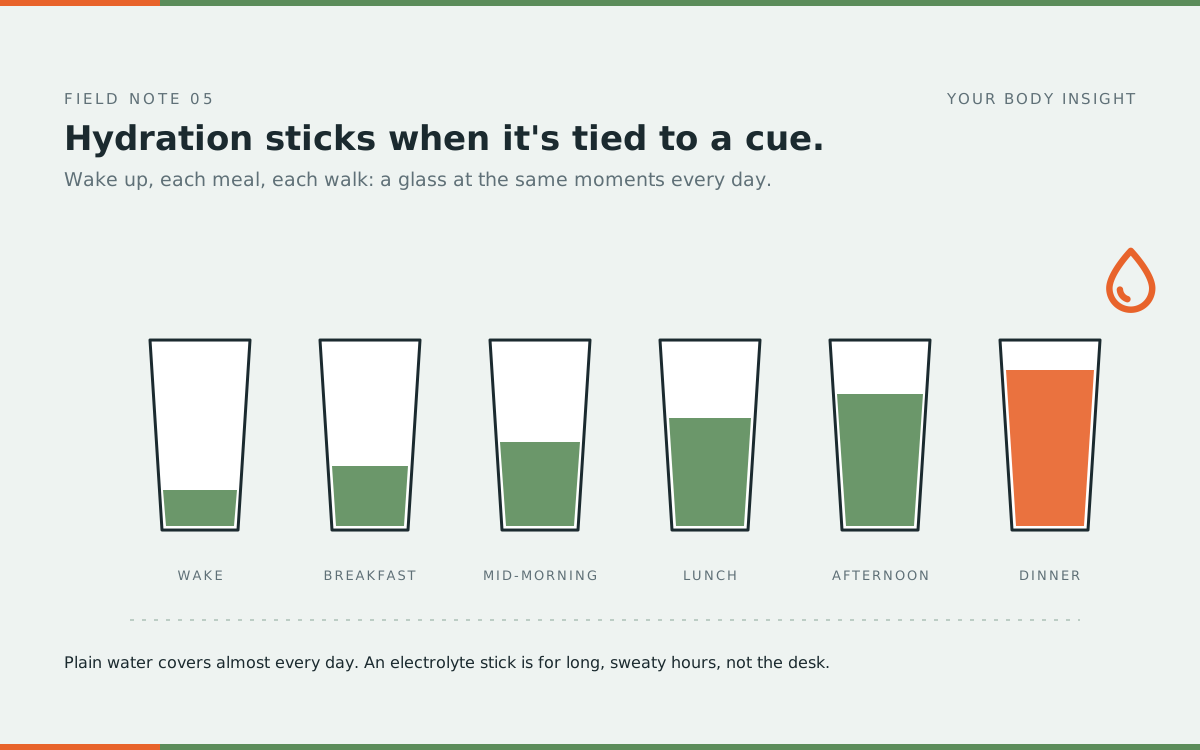
Habits survive when they are attached to something that already happens. Deciding to drink “more” fails; drinking at six fixed moments does not, because the moment does the reminding. This is the day the cover illustration shows, in order.
- Wake up: one glass before anything else. Keep it on the nightstand or next to the kettle, so it is poured before you have decided anything. Coffee afterward counts toward the total too.
- Breakfast: a glass with the meal. Meals are the easiest cues because you are already at a table with a cup within reach.
- Mid-morning: refill at the stand-up break. If you keep the every-30-minutes rhythm from our desk-worker note, the refill is the reason to get up and the walk comes free.
- Lunch: water first, then whatever else you planned to drink. Put the glass down before the food arrives; an empty glass at the end of lunch is the whole habit.
- Afternoon: the bottle goes on the walk. A 20-minute walk at three o’clock with a bottle in hand does two habits at once. On hot days it is the one moment you may actually feel thirsty, so answer it.
- Dinner: a glass with the meal, then taper. Front-loading the day means you are not drinking a liter at ten at night and waking up at two. Our evening-routine note covers the rest of that wind-down.
Six glasses of 8 to 12 ounces is 48 to 72 ounces before coffee, tea, milk or food. For many women that lands near the reference; many men will want a second refill at one of the afternoon cues. The point is not the arithmetic. It is that you never have to remember to drink, only to wake, eat and walk, which you were going to do anyway.
When an electrolyte mix earns its place
Electrolyte drink mixes are sports-medicine tools that moved into the office. The sports-medicine rule for when they help is narrower than the marketing. The American College of Sports Medicine’s position stand on exercise and fluid replacement sets the goal of drinking during exercise as avoiding a fluid deficit greater than 2 percent of body weight, notes that sweat rate and sweat electrolyte content vary considerably between individuals, and says beverages with electrolytes and carbohydrates “can provide benefits over water alone under certain circumstances,” which is a deliberately limited phrase (source 2). The stand’s practical tip is worth borrowing: estimate your own sweat rate by weighing yourself before and after a session. The earlier 1996 stand puts the conversion at about a pint (16 ounces) of fluid per pound lost (source 3).
The numbers behind “certain circumstances” are laid out in the ACSM’s earlier position stand from 1996, which the 2007 stand later replaced. Sodium in sweat averages about 50 millimoles per liter and can range from 20 to 100 depending on heat acclimation, diet and hydration; by our arithmetic that average is roughly 1.1 grams of sodium in every liter of sweat. For exercise lasting longer than an hour, it recommended about 0.5 to 0.7 grams of sodium per liter of fluid, and 600 to 1,200 milliliters of fluid per hour (source 3). It also documents the flip side: in a very small number of marathon and ultra-marathon athletes, drinking large volumes of plain water over many hours diluted blood sodium to a dangerously low level, which is the one strong argument for having sodium in the fluid or food during very long efforts, the stand says over four hours (source 3).
So the test is two questions. Did you sweat steadily for an hour or more, or work in serious heat? And would you otherwise not drink enough? A yes to either and an electrolyte stick is doing a real job. A desk day, a 30-minute walk, a gym session with the air conditioning on, or a Monday morning fail both questions; there, plain water with meals covers it. Fluid loss from an illness is a different situation and one for a clinician, not for a drink mix chosen from an ad.
“Faster hydration than water alone” and similar lines are the seller’s claims. On its ingredients page the brand describes glucose as there “to help your body absorb water” and sodium “to help your body retain and distribute water” (source 4). That pairing is about the sweat scenario; on a desk day there is no deficit for it to work on.
The sodium trade-off
Here is what one stick of the Lemon Lime Hydration Multiplier in our catalog contains, per the Nutrition Facts panels we read on September 30, 2026: 500 mg of sodium (22 percent of the Daily Value) on the panel shown on the Amazon listing, or 560 mg (24 percent) on the panel on the brand’s own product page, plus 370 mg of potassium, 11 g of added sugar and 45 to 50 calories, mixed into 16 ounces of water (source 6). Our Liquid I.V. entry sets the two panels side by side and tracks the Amazon listing and its dated price.
Now set the sodium next to the reference lines. The FDA’s Daily Value for sodium is less than 2,300 mg a day, about a teaspoon of table salt; Americans already eat about 3,400 mg a day on average; and the FDA’s own reading rule is that 20 percent of the Daily Value or more in one serving “is considered high” (source 5). The National Academies’ adequate intake for adults aged 19 to 50 is lower still, 1.5 grams a day, with a tolerable upper level of 2.3 grams (source 1).
That is the whole trade-off in two lines. After a two-hour run in July, 500 to 560 mg of sodium replaces roughly half of what a liter of sweat at the average concentration carried off (less if you are a salty sweater), and the stick is doing what it was designed to do. At a desk, the same stick is a high-sodium serving by the FDA’s 20 percent rule added to a day that, on average, is already over the limit, plus 11 g of sugar you did not need because there was nothing to absorb faster. Read the sodium line on any stick the way our label-reading note describes, and count it in the day’s total.
If a clinician has told you to limit fluids or sodium, or you take medication that affects fluid balance, that instruction overrides every general figure in this note, including the adequate-intake liters. The same applies if you have a diagnosed condition of any kind: ask before adding an electrolyte product to your routine.
Keeping it going
- Measure once a week, not once a day. Count bottle refills on one ordinary day a week. If a 24-ounce bottle went around three times, you had 72 ounces before food and coffee, and you can stop thinking about it.
- Change the cues with the season, not the goal. In summer or during a heat wave, add one cue (the afternoon walk becomes two bottles) instead of trying to “drink more.”
- Keep water in sight. A bottle on the desk gets drunk; a bottle in a bag does not. Choose a size you know, so a refill is a number rather than a guess.
- If it slips, restart at the wake-up glass. It is the cue that depends on nothing else, and one kept cue tends to pull the others back.
- Keep the sticks for the days that pass the two-question test. Buy the pouch, keep it in the gym bag, and leave it there.
Sources
- National Academies of Sciences, Engineering, and Medicine. News release on the 2004 Dietary Reference Intakes for water, potassium, sodium, chloride and sulfate: adequate intakes for total water, the share from food, caffeinated beverages, thirst as a guide, and the sodium figures. February 2004. link
- Sawka MN, Burke LM, Eichner ER, Maughan RJ, Montain SJ, Stachenfeld NS. American College of Sports Medicine position stand on exercise and fluid replacement (abstract). Medicine & Science in Sports & Exercise, 2007;39(2):377–390. PubMed record link
- Convertino VA, Armstrong LE, Coyle EF, Mack GW, Sawka MN, Senay LC Jr, Sherman WM. American College of Sports Medicine position stand on exercise and fluid replacement (1996 edition): sodium and fluid amounts during exercise over one hour (abstract), plus sweat sodium concentration, the pint-per-pound rule and the risk of over-drinking plain water in very long events (full text). Medicine & Science in Sports & Exercise, 1996;28(1):i–vii. PubMed record link; full-text copy reproduced by permission of the ACSM on the Kentucky High School Athletic Association site link (PDF)
- Liquid I.V. Product ingredients page: the brand’s description of the roles of glucose and sodium in its Hydration Multiplier. link
- U.S. Food and Drug Administration. Sodium in Your Diet: the Daily Value, average U.S. intake, and how to read the percent Daily Value. link
- Nutrition Facts panels for Liquid I.V. Hydration Multiplier, Lemon Lime (Amazon listing and brand product page), read September 30, 2026; compared in our Liquid I.V. entry.
This article is educational and is not medical advice. Ask a qualified clinician before starting any supplement or changing a routine, especially if you take medication, have a diagnosed condition, or have been told to limit fluids or sodium.