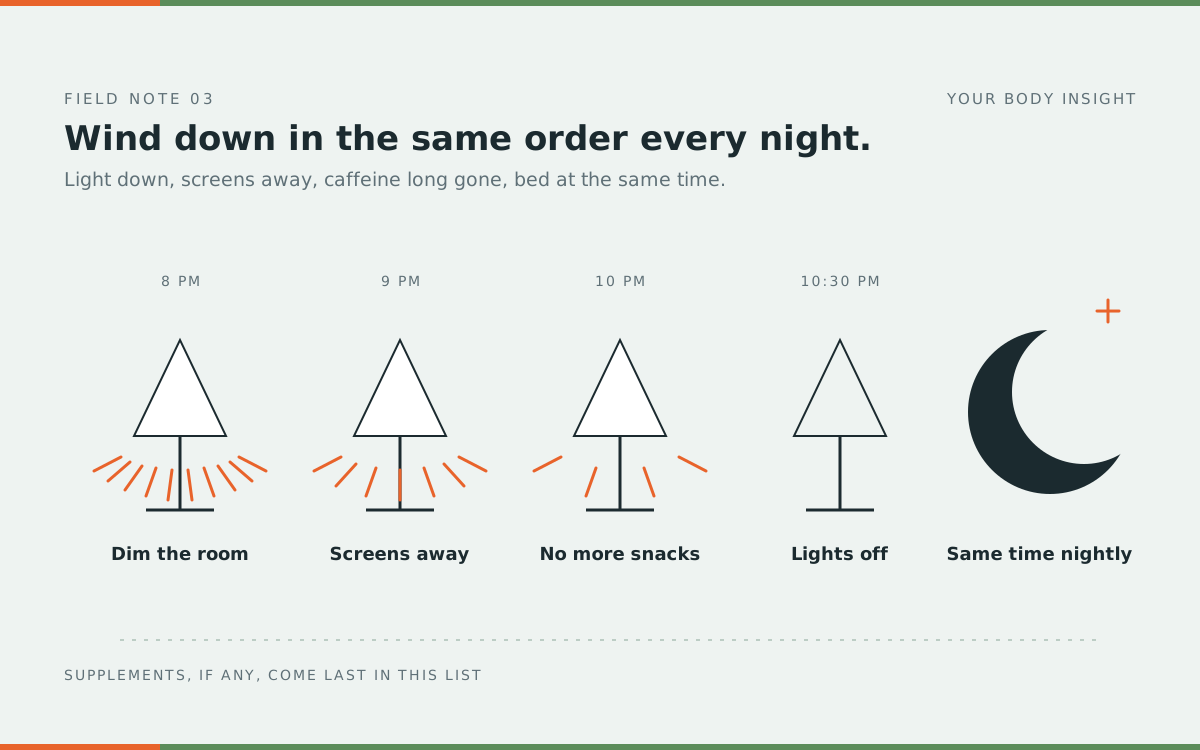
The question behind most searches for a sleep supplement is simpler than the product pages make it: what should the last few hours of the day look like so that falling asleep is easier and the morning is less of a fight? The evidence-backed answer is a routine, not a capsule. Light, caffeine, the order you do things in and the time you get up all have measurable effects, and they cost nothing. Melatonin and magnesium come at the very end of this note, with the numbers from the trials and the cautions that belong beside them.
What you are aiming for
The CDC's guidance for adults 18 to 60 is seven or more hours of sleep a night, with seven to nine for adults 61 to 64 and seven to eight from 65. The American Academy of Sleep Medicine (AASM) turns that into a planning rule: set a bedtime early enough to allow at least seven to eight hours, and get up at the same time every day, including weekends and vacations. The fixed wake time is the anchor. Everything else in the routine is counted backward from it.
Two of the ingredients of a good evening are set in the afternoon. In a small study run in participants' own homes, twelve adults took 400 mg of caffeine, roughly what a large brewed coffee can contain, either at bedtime, three hours before or six hours before, on separate nights, with a placebo night for comparison. Even the six-hour dose cut objectively measured total sleep by more than an hour (about 1.1 hours on the in-home monitor), while the participants' own sleep diaries showed a smaller loss of about 41 minutes that did not reach statistical significance. The authors concluded that substantial caffeine should stop at least six hours before bed, and suggested before 5 p.m. as a minimum rule for moderate to large doses.
The other is light. In a two-week inpatient crossover study, twelve healthy young adults read for about four hours before bed on five consecutive evenings from a light-emitting tablet and on five from a printed book. On tablet nights they took about ten minutes longer to fall asleep, their evening melatonin levels were reduced by about 55%, their internal clock shifted about an hour and a half later, and they reported being sleepier the next morning. Both studies are small, and the reading study was run in a laboratory rather than on ordinary evenings at home, so the exact numbers will vary from person to person; the direction of the effect is what matters for a routine.
Pick the wake time first and keep it seven days a week. Then work backward: bedtime eight hours before, screens off half an hour before that, caffeine done six hours before that.
The routine, counted back from your wake time
- Six hours before bed: last caffeine. Coffee, tea, energy drinks, pre-workout powders and some sodas and pain relievers all count. If your bedtime is 11 p.m., the cut-off is 5 p.m.
- Three hours before bed: last large meal, and no alcohol. Both the CDC and the AASM list avoiding large meals and alcohol before bed as core habits. Alcohol may make it easier to drop off but tends to make sleep lighter and more broken later in the night. If you are hungry late, keep it to a light snack.
- Ninety minutes before bed: dim the house. Turn off overhead lights and use lamps; the AASM's advice is to limit exposure to bright light in the evening. This is also a good point to reduce fluid intake so you are less likely to wake to use the bathroom.
- Thirty minutes before bed: screens off, same wind-down every night. The CDC and the AASM both say to turn off electronic devices at least 30 minutes before bedtime. Fill the half hour with a short fixed sequence you do in the same order: tidy the kitchen, shower, stretch, read on paper. The order matters more than the contents, because a repeated sequence becomes the cue.
- At bedtime: only if you are sleepy. The AASM's rule is not to go to bed unless you are sleepy, and if you have not fallen asleep after about 20 minutes, to get up, do something quiet in low light without electronics, and return when you are. Lying awake in bed teaches the bed to be a place you lie awake.
- The room you sleep in: quiet, dark, cool. Keep it quiet and relaxing, at a comfortable, cool temperature, and keep devices out of it if you can. An eye mask and earplugs are an inexpensive way to test whether light or noise is the problem before you spend on anything bigger.
- At wake time: up, light on, same time as yesterday. Get up at the fixed time even after a bad night, and get bright light early. Sleeping in to recover shifts the next night later, which is how a single bad night becomes a bad week.
Where melatonin fits
Melatonin is a substance your brain makes in response to darkness that helps time your sleep, and exposure to light at night reduces it, which is why the dimming step above comes before any supplement. Taken as a pill it is not a sedative. The best-known pooled analysis, covering 19 trials and 1,683 adults and children with diagnosed sleep problems, found that on average melatonin shortened the time to fall asleep by about 7 minutes and lengthened total sleep by about 8 minutes, with a small improvement in rated sleep quality. Those are real but modest numbers, and they are averages across trials that used a range of doses and lengths; trials with higher doses and longer durations showed somewhat larger effects on falling asleep and total sleep. NCCIH notes that a 2015 safety review found only mild side effects in short-term studies, such as headache, dizziness, nausea and sleepiness, and that possible long-term effects are unclear.
Two cautions are specific to melatonin as a product. First, what is in the bottle: NCCIH cites a 2017 study of 31 products in which most did not match their labeled melatonin content, and 26% contained serotonin, a compound that can cause harm even at relatively low levels. A 2023 study of 25 gummy products found one with no detectable melatonin and the rest ranging from 74% to 347% of the labeled amount. The AASM's 2022 advisory on melatonin use in children tells parents to choose a product carrying the USP Verified Mark, while noting that the program is voluntary and that only four melatonin products, all 3 mg or 5 mg, held it at the time. Second, who should not self-prescribe it: NCCIH notes there has been a lack of research on its safety in pregnancy or breastfeeding, that it may stay active longer in older adults and cause daytime drowsiness, that children should not be given it without a healthcare professional's advice, and that people with epilepsy and people taking blood thinners need medical supervision. Melatonin labels, including Natrol's, also warn against driving or operating machinery after taking it.
The Natrol Melatonin 5 mg entry reads that label, compares 5 mg with the amounts used in studies, and lists what else is in a fast-dissolve tablet. Natrol markets it for occasional sleeplessness; that is the seller's phrase, and this note makes no claim of its own. If you try it, the spirit of the AASM's advice on children applies to adults too: many sleep problems are better managed with a change in schedule and habits than with a supplement, so run the routine first.
Where magnesium fits
Magnesium is a mineral with an adult RDA of 400 to 420 mg a day for men and 310 to 320 mg for women, and it is popular as an evening supplement. The trial evidence is thin. A 2021 systematic review found only three randomized trials, all in older adults with sleep complaints, pooling to about 17 minutes less time to fall asleep than placebo, and rated the evidence low to very low quality. That is a reason to be cautious about expecting much, not a reason to rule it out for someone whose diet is low in magnesium.
The label questions are the ones covered in our Supplement Facts field note: the panel amount is the mineral itself, the form is in parentheses, and the Tolerable Upper Intake Level for magnesium from supplements is 350 mg a day, a limit set at the point where loose stools become likely. A scoop of the Thorne Magnesium Bisglycinate powder lists 200 mg of magnesium, which sits under that limit on its own but needs to be added to any multivitamin or other magnesium product you take. Thorne markets it for relaxation and sleep support, which is the seller's position. People with kidney problems, and anyone taking antibiotics, bisphosphonates or diuretics, should ask a clinician or pharmacist first, because magnesium can reduce the absorption of some antibiotics and bisphosphonates, and some diuretics change how much magnesium the body keeps.
Sleep that stays poor for more than a few weeks despite a consistent routine, loud snoring or pauses in breathing noticed by someone else, or heavy daytime sleepiness. Those are reasons to talk to a clinician, and no supplement on this site is a substitute for that conversation.
A two-week way to test it
Write your wake time on a card and put it by the bed. For fourteen days, hold that time, stop caffeine six hours before bed, dim the house ninety minutes out, put screens away thirty minutes out, and run the same short wind-down in the same order. Note two things each morning: roughly how long it took to fall asleep, and how you felt an hour after waking. If after two weeks you want to add melatonin or magnesium, add one at a time so you can tell what it did, choose a product whose label you have actually read, and clear it with a clinician or pharmacist if you take any medication, are pregnant, or are buying it for a child.
Sources
- Centers for Disease Control and Prevention. About sleep: recommended hours by age and habits for better sleep. cdc.gov
- American Academy of Sleep Medicine. Healthy sleep habits (consistent schedule, bedtime routine, light, electronics, meals, caffeine, alcohol, the 20-minute rule). sleepeducation.org
- Drake C, Roehrs T, Shambroom J, Roth T. At-home study of 400 mg caffeine taken 0, 3 or 6 hours before bed in twelve adults. Journal of Clinical Sleep Medicine, 2013. pmc.ncbi.nlm.nih.gov
- Chang AM et al. Inpatient crossover study (five evenings per condition) of evening reading on a light-emitting device versus a printed book in twelve healthy adults. Proceedings of the National Academy of Sciences, 2015. pmc.ncbi.nlm.nih.gov
- National Center for Complementary and Integrative Health. Melatonin: what you need to know (safety, side effects, label-content studies, who should be cautious). nccih.nih.gov
- Ferracioli-Oda E et al. Pooled analysis of 19 melatonin trials (1,683 participants with primary sleep disorders): time to fall asleep, total sleep time and sleep quality. PLoS One, 2013. pubmed.ncbi.nlm.nih.gov
- American Academy of Sleep Medicine. Health advisory on melatonin use in children and adolescents, adopted September 2022 (label-content variability, USP Verified mark). aasm.org
- Mah J, Pitre T. Systematic review and pooled analysis of three randomized trials (151 participants) of oral magnesium for sleep complaints in older adults. BMC Complementary Medicine and Therapies, 2021. pubmed.ncbi.nlm.nih.gov
- Linus Pauling Institute, Oregon State University. Magnesium: RDA, supplement forms, and the 350 mg/day upper level for supplemental magnesium. lpi.oregonstate.edu
- Thorne. Magnesium Bisglycinate product page (Supplement Facts as read September 30, 2026). thorne.com
This article is educational and is not medical advice. Ask a qualified clinician before starting any supplement or changing a routine, especially if you take medication.